Tim Jackson

- Professor
- Department Chair
Contact Info
1567 Irving Hill Rd
Lawrence, KS 66045
1567 Irving Hill Rd
Lawrence, KS 66045
Personal Links
Education —
2005-2007
Specialization
- Bioinorganic Chemistry
- Biomimetic Chemistry
- Biophysical Chemistry
Research —
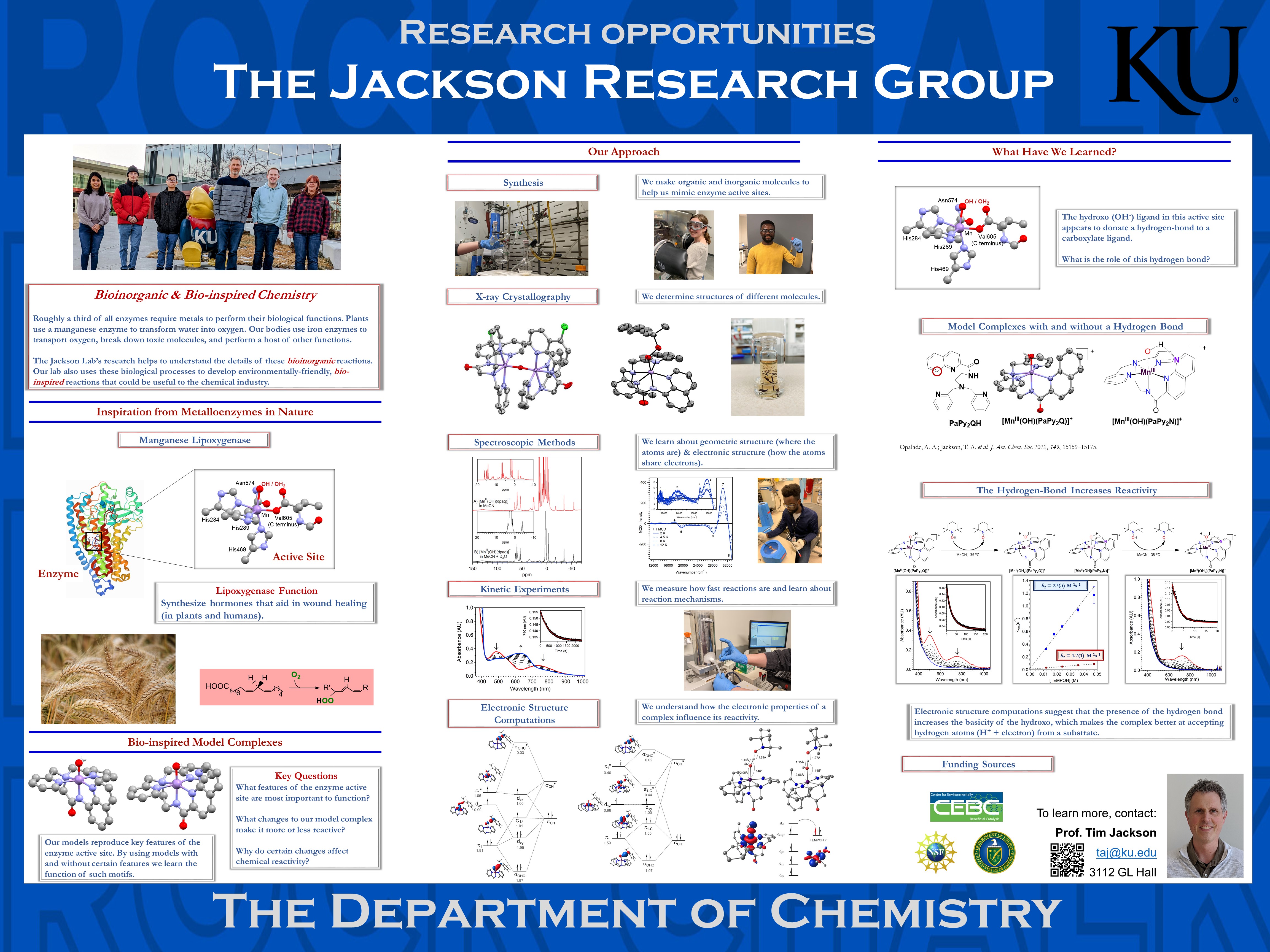
Nature uses metalloenzymes containing Mn, Fe, or Cu and oxidants such as molecular oxygen and hydrogen peroxide to carry out remarkable oxidative transformations that are both vital for life and fascinating from a fundamental perspective. Such reactions also serve as inspiration for synthetic chemists, as catalytic processes that utilize earth-abundant metals are less expensive and more environmentally benign than conventional process that employ precious-metals. Our research focuses on using synthetic model complexes to understand the chemical reactions that are critical to the function of both metalloenzymes and earth-abundant metal catalysts. These reactions include activation of dioxygen (O2) and hydrogen peroxide (H2O2) and the cleavage of C-H and O-H bonds by high- and mid-valent metal-oxygen species. To achieve these goals, the Jackson lab uses a combination of i) synthetic and kinetic methods to generate and characterize the reactivity patterns of metal ion complexes, ii) detailed spectroscopic characterization of transition-metal species, and iii) computational chemistry. These combined efforts allow us to identify geometric and electronic properties of transition-metal complexes that influence chemical reactivity.
Spectroscopic methods used in our research include electronic absorption (UV-vis), electron paramagnetic resonance (EPR), magnetic circular dichroism (MCD), and X-ray absorption (XAS) spectroscopies. We also employ NMR methods to probe the solution structures of paramagnetic complexes. These tools are particularly powerful when used in conjunction with computational methods, as they permit the characterization of the geometric and electronic structures of fleeting intermediates too unstable to be characterized using standard crystallographic methods. Our lab also used kinetic studies to probe the reaction mechanisms of our complexes. By applying this three-pronged approach to bio-inspired transition-metal complexes, we gain detailed insight into how nature uses molecular oxygen and earth-abundant metals to oxidize substrates and apply this knowledge to develop transition metal complexes that can perform green oxidation reactions.
Selected Publications —
Puthiyadath, A.; Jackson, T. A. Comparing the Thermodynamic Properties and Reactivity of FeIII- and MnIII–Hydroxo Complexes. Inorg. Chem. 2025, 64 (51), 25294–25304. DOI: 10.1021/acs.inorgchem.5c04654.
Gupta, S.; Arora, P.; Aghaei, Z.; Singh, B.; Jackson, T. A.; Draksharapu, A. Formation and Reactivity of a MnIV(O)(μ-O)CeIV Species: A Closest Mimic of Photosystem II. J. Am. Chem. Soc. 2025, 147 (1), 619–626. DOI: 10.1021/jacs.4c12523.
Zhu, H.; Jackson, T. A.; Teator, A. J.; Subramaniam, B. Oxidative Functionalization of Solvent-Pretreated Polyethylene by Ozone. ACS Sustainable Chemistry & Engineering 2025, 13 (13), 4988–4996. DOI: 10.1021/acssuschemeng.4c09279.
Singh, P.; Massie, A. A.; Denler, M. C.; Lee, Y.; Mayfield, J. R.; Lomax, M. J. A.; Singh, R.; Nordlander, E.; Jackson, T. A. C–H Bond Oxidation by MnIV–Oxo Complexes: Hydrogen-Atom Tunneling and Multistate Reactivity. Inorg. Chem. 2024, 63 (17), 7754–7769. DOI: 10.1021/acs.inorgchem.4c00186.
Kayne, M.; Murphy, P. S.; Kwon, Y. M.; Lee, Y.; Jackson, T. A.; Wang, D. Generation, Characterization and Reactivity of a High-Valent Mononuclear Cobalt(IV)−Diazide Complex. Chem. Eur. J. 2024, 30 (35), e202401218. DOI: https://doi.org/10.1002/chem.202401218.
Grotemeyer, E. N.; Aghaei, Z.; Jackson, T. A. Spectroscopic Properties and Reactivity of a MnIII-Hydroperoxo Complex that is Stable at Room Temperature. Chem. Eur. J. 2024, 30 (70), e202403051. DOI: https://doi.org/10.1002/chem.202403051.
Awards & Honors —
2026 Honorary Inductee, Phi Beta Kappa
2025 Fellow, American Association for the Advancement of Science
2024 William T. Kemper Fellowship for Teaching Excellence, University of Kansas
2023 University Scholarly Achievement Award, University of Kansas
2022 Visiting Faculty, Université Grenoble Alpes, Grenoble, France, May – June 2022
2015 Visiting Faculty, Université Paris Diderot, Paris, France, March 2015
2014 Outstanding Educator Award, Board of Class Officers, University of Kansas
2012 Chancellor’s Silver Anniversary Teaching Award, University of Kansas
2011 – 2016 National Science Foundation CAREER Award, University of Kansas
2005 American Chemical Society Young Investigator Award – Division of Inorganic Chemistry