Professor Ward Thompson named August 2025 Sutton Family Research Impact Award recipient
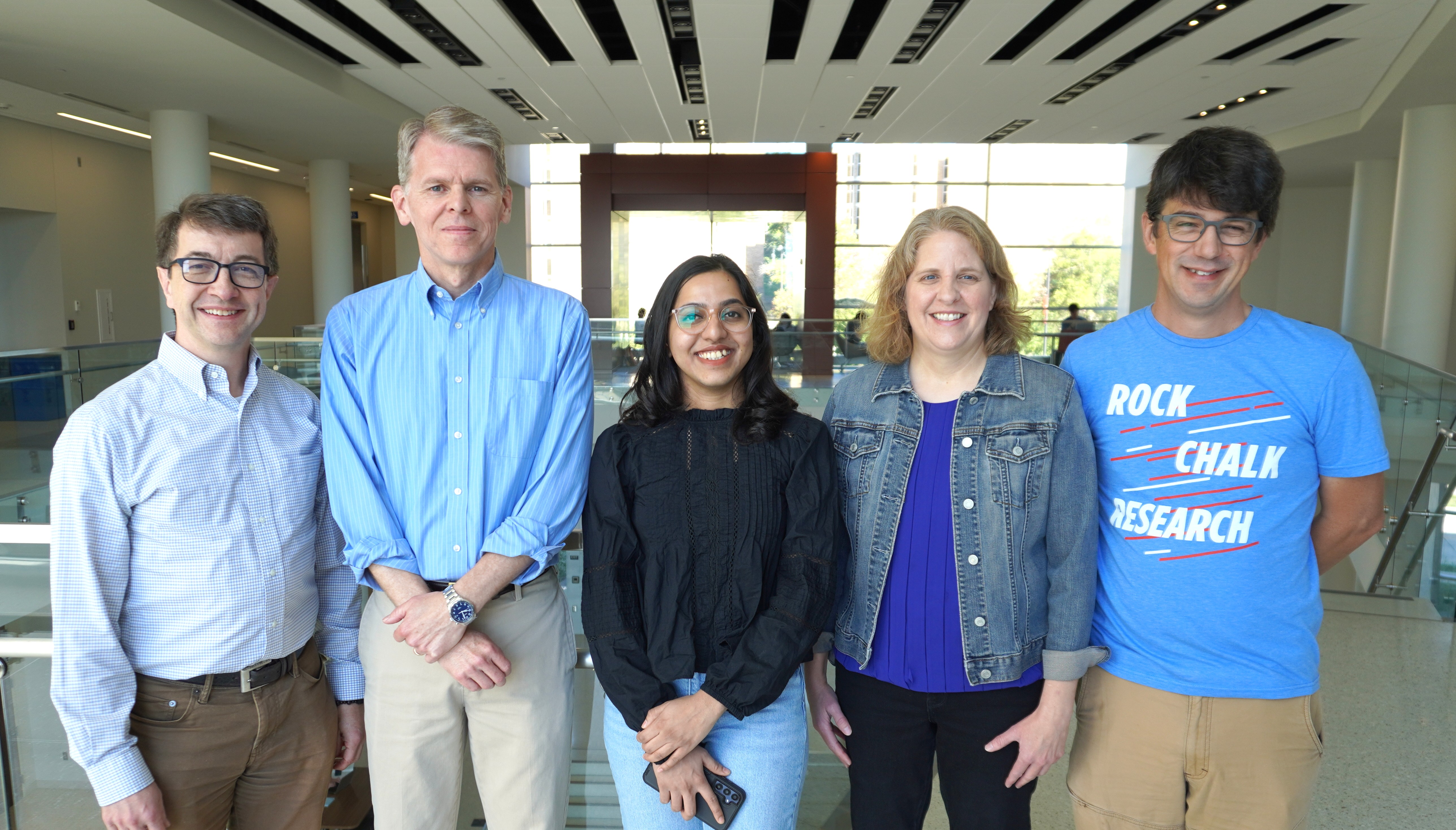
Members of the collaborative team, from left to right, Prof. Alan M. Allgeier (Chemical and Petroleum Engineering), Prof. Ward H. Thompson (Chemistry), Anjali Radhakrishnan (Chemistry graduate student), Sarah A. Neuenswander (NMR Core), and Dr. Justin T. Douglas (NMR Core). Not Shown: Dr. Ashley K. Borkowski (Chemistry PhD, 2023) and Khanh V. Le (Chemical Engineering B.S., 2024).
The Department of Chemistry congratulates Professor Ward Thompson on receiving the August 2025 Sutton Family Research Impact Award!
The Sutton Award is a monthly competition among chemistry faculty. Every month, the Chemistry Department Chair and Associate Chairs review the peer-reviewed papers published by chemistry faculty from the three previous months to select a winner. The recipient receives a $500 cash prize and is featured on the departmental website.
For a full list of winners, visit our Sutton Family Research Impact Award webpage.
Osmolyte effects on water diffusion: Urea induces changes in the entropic barrier, TMAO in the energetic barrier
By Anjali Radhakrishnan, Ashley K. Borkowski, Khanh V. Le, Alan M. Allgeier, Sarah A. Neuenswander, Justin T. Douglas, and Ward H. Thompson*
Journal of Chemical Physics, 2025, 162, 231101
Osmolytes are small organic molecules that help maintain water balance in cells. At the same time, they can have significant impacts on the structure of proteins. This is typically characterized by ordering them in the Hofmeister series, a ranking (usually of ions, but also osmolytes) based on their tendency to induce protein unfolding (“structure breakers”) or assist in maintaining protein folds (“structure makers”). There are two competing views about the mechanism of these osmolyte effects on proteins. A direct mechanism has been proposed in which the osmolyte’s effect occurs through interaction of the osmolyte with the protein backbone. Others suggest an indirect mechanism in which the osmolyte modifies the solvating water structure that, in turn, modifies the stability of the folded protein.
This project involved a theoretical-experimental collaboration and the contributors (still at KU) are shown in the photo above. In the paper, simulations from the Thompson group were combined with NMR measurements to investigate the indirect mechanism as it relates to water dynamics. Specifically, they used water diffusion as a probe of the effect of two osmolytes: urea, which tends to denature proteins, and trimethylamine N-oxide (TMAO), which tends to induce protein folding. A key aspect of the work is the use of activation energies to understand the driving forces for changes in the water diffusion as osmolyte is added.
Both simulations and experiments show that adding urea or TMAO (up to concentrations of 8M) slows down water diffusion, with TMAO having a stronger effect. However, the activation energies demonstrate that the origin of this similar behavior is completely different for the two osmolytes. The activation energy for the water diffusion coefficient stays the same or slightly decreases as urea is added. In contrast, as the TMAO concentration is increased, the activation energy grows significantly.
This indicates that urea changes the water dynamics by increasing the entropic barrier – in short, urea gets in the way of the water molecules as they try to move. This strongly suggests that urea cannot influence protein folding through an indirect effect, but must operate through direct interactions with the protein. On the other hand, as TMAO is added to water, it changes the energetic barrier to water motion while the entropic barrier appears to decrease. Preliminary indications are that this occurs by TMAO inducing changes in the hydrogen-bond network of the water molecules such that the water molecules find it harder to exchange hydrogen-bond partners.
These results indicate there is much more to investigate with respect to the effects of different osmolytes on water structure and dynamics. This includes identifying the osmolyte molecular characteristics (e.g., size, hydrogen-bonding ability, hydrophobic bulk) that generate these different energetic and entropic effects on water dynamics as well as correlating them to effects on protein structure.