Assistant Professor Manar Shoshani named November 2025 Sutton Family Research Impact Award recipient
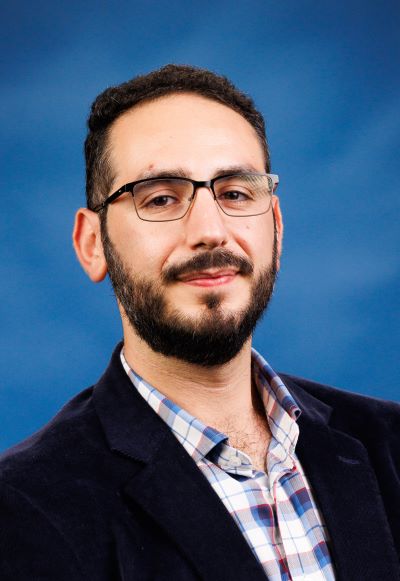
The Department of Chemistry congratulates Assistant Professor Manar Shoshani on receiving the November 2025 Sutton Family Research Impact Award!
The Sutton Award is a monthly competition among chemistry faculty. Every month, the Chemistry Department Chair and Associate Chairs review the peer-reviewed papers published by chemistry faculty from the three previous months to select a winner. The recipient receives a $500 cash prize and is featured on the departmental website.
For a full list of winners, visit our Sutton Family Research Impact Award webpage.
A Ni-Al Hydride Cluster Bearing Site-Differentiated Al Centers: Demonstration of Olefin Insertion and Alkyl Transfer
By Jordan R. Gipper, Sergio Gonzalez-Eymard, Julia Abdoullaeva, Marco Caricato, and Manar M. Shoshani
Inorg. Chem. 2025, 64, 21317-21322. https://doi.org/10.1021/acs.inorgchem.5c02694
Lewis-acidic additives are extensively used in transition-metal catalysis to enhance or enable reactivity and control selectivity, yet their precise roles are often poorly understood. Gaining a clearer picture of how these additives function would enable the tailored design of catalysts for challenging molecular transformations. Among the most common additives are aluminum-based reagents, which are attractive due to their Earth-abundance and Lewis-acidic nature. Al has been shown to influence selectivity in C–H functionalization, enhance CO₂ reduction capabilities, and enable liquid fuel formation from simple feedstocks, such as ethylene. Despite this broad utility, the specific role of Al in many catalytic systems remains nebulous.
This challenge arises in part because Al can adopt multiple bonding modes when bound to transition metals. Al can act as a neutral “alane” (which can serve a sigma-donating, or sigma-accepting role), an anionic “aluminyl,” or a low-valent Al(I) species known as an aluminylene, making direct comparisons between these motifs difficult.
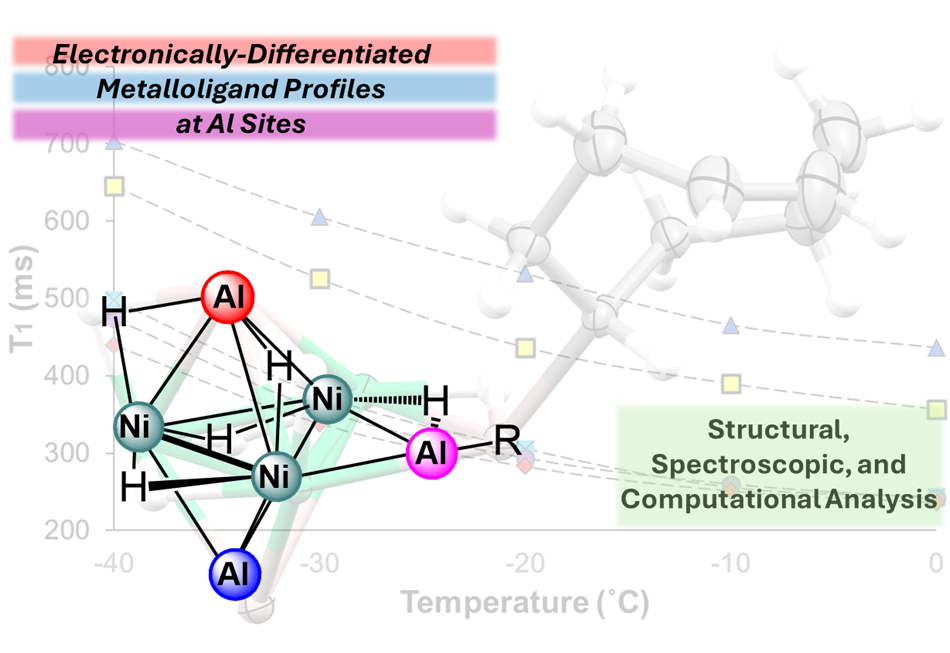
Figure 1: Cluster 1 with electronically differentiated Al centers indicated by color. Red: sigma-donating alane, pink: sigma-accepting alane, blue: aluminyl/aluminylene.
In this work, we report a Ni–Al cluster, complex 1, [LNiAl]₃H₅R (R = 4-cyclooctenyl), that brings several of these Al modalities together within a single, well-defined structure. The cluster features electronically distinct Al and Al-hydride units capping a trinickel core, enabling the explicit characterization of the Al centers as sigma-donor, sigma-acceptor, and aluminyl/aluminylene modalities, Figure 1. This unique arrangement in 1 enables direct comparison and distinction using structural, spectroscopic, and computational comparison. In addition, we were able to utilize spin-lattice relaxation times in NMR spectroscopy to further distinguish the Al-base ligand modalities spectroscopically, a technique that had traditionally been used to differentiate metal-dihydrogen complexes from metal-hydrides.
Furthermore, formation of cluster 1 proceeds through olefin insertion and subsequent alkyl transfer to Al under remarkably mild conditions. Observation of these fundamental elementary steps within a single, well-defined system highlights the capacity of Al and Ni to cooperatively mediate key bond-forming processes. In addition to continuing our work in exploring the coordination chemistry of highly reducing Al-metalloligands, our team will also explore utilizing the observed elementary steps towards novel catalytic strategies in which olefinic substrates are housed at Al sites, positioning them for cooperative bond formation in concert with transition-metal centers.